A) This course goal was met through the lectures as the transmission of disease and how the body protects people was explained. In areas where primary prevention is not as strong (due to the lack of funding/ resources) communicable disease is a larger concern. For example, the course reading by Iwu and Holzemer (2014), explains that HIV/AIDS is remains a major public heath concern in Africa. Africa has a severe shortage of health care workers and with the umber of people affected by the disease, it makes it nearly impossible for people to be treated. Task shifting was a proposed plan to enhance the availability of people to obtain treatment. It was explained that a new affordable drug is to be introduced to Africa in order to help keep the disease at bay. The lecture also described how HIV and TB are among the top killers in undeveloped countries. The lack of a strong economical status makes it hard for these countries to treat and prevent disease. Although there is no cure for HIV/AIDS, there are antivirals to help keep the disease at bay. Healthcare workers can provide this medication to help prevent the spread of disease in developing countries. The lecture also describes how the co infection of TB and HIV is the leading cause of death for adults who have HIV and are not taking antiviral medication. it is recommended that if a person is diagnosed with one of the diseases, that they get tested for the other, so proper treatment can be initiated.
B) Evidence outside of course content
Evidence 1:
Migliori, G. B., Dheda, K., Centis, R., Mwaba, P., Bates, M., O’Grady, J., Zumla, A. (2010). Review of multidrug-resistant and extensively drug-resistant TB: global perspectives with a focus on sub-Saharan Africa. Tropical Medicine & International Health, 15(9), 1052–1066. https://doi-org.ezproxy.library.yorku.ca/10.1111/j.1365-3156.2010.02581.x
This article explains how multi-drug resistant tuberculosis is becoming a problem non developed countries. This is due in part to the lack of funding and money of the healthcare system and the patients seeking treatment. People do not always have the money or the means to follow through on treatment, which can lead to medication regimens not being followed properly. When medication regimens are not followed properly, it can lead to strong strains of disease (Migliori et al., 2010). This relates to course content because it describes the disparities that developing countries face.
Evidence 2:
UNICEF. (n.d.). Water, sanitation and hygiene. Retrieved from https://www.unicef.org/wash/
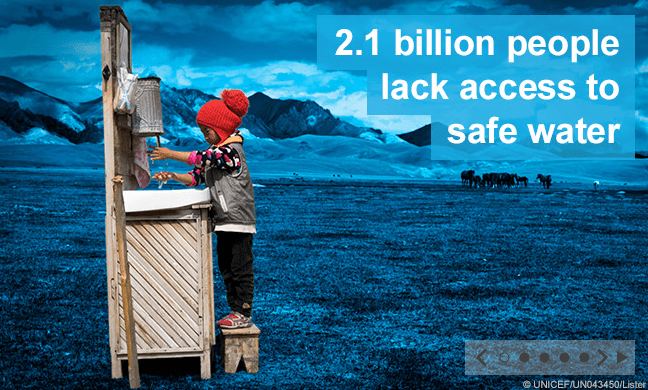
According to UNICEF (n.d.), approximately 2.1 billion people worldwide do not have access to clean water. Unsafe water and lack of sanitation can lead to the spread of disease. For example, lack of sanitation and clean drinking water is one of the biggest causes of death for children under five (UNICEF, n.d.). The disease that children can get are preventable, however they do not have the means to obtain vaccines or ways to clean the water. This source of information relates to course content as it is a health concern in developing countries which can lead to the transmission of disease and can cause death to people across the world.
 Global Health Nursing